

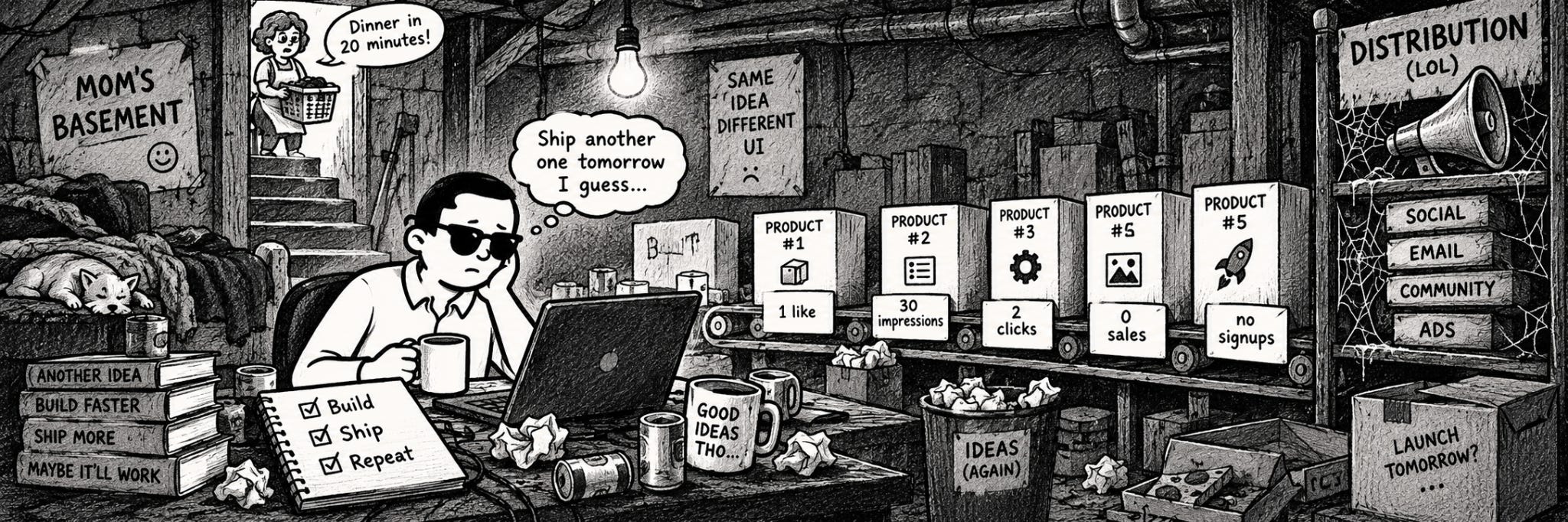
If you’re a builder on X with no audience, read this article to the end before you launch anything new. I say this specifically because I was once where you are.
I’m going to give you 8 very specific and actionable jobs you need to do right now.
After growing to 130,000+ followers on X, these 8 jobs is the exact distribution system I’d use today if I had to start all over again from zero.
Before we dive in though.
Tell me if you’ve ever felt this particularly depressing moment that almost every new builder eventually experiences.
You’ve spent the last month building something you genuinely believe is good. You’ve redesigned the onboarding maybe three times. You fixed the stupid edge case that kept breaking on mobile. You rewrote the homepage until every sentence started looking fake. Maybe you even delayed launching for another week because the product still didn’t feel quite ready, although deep down you knew another week wasn’t going to change much.
Then... you finally ship it.
You write your launch post, attach a polished screenshot, hit publish, and spend the next hour checking X like an insane person.
After all the build in public posts you did the past months, someone out there has to care... right? RIGHT?!?!?!
73 impressions.
4 likes.
Two of them are people you already know in real life.
And then all of a sudden, it happens... a new reply!
YES!
A crypto bot.
The most painful part of all this is that you literally have no idea what conclusion to draw from this.
Maybe the product is bad. Maybe the landing page just didn’t hit. Maybe your positioning of the product sucks. Maybe you just built something that no one really wants.
The silence feels like feedback that you suck.
But here’s the thing...
Sometimes it’s as simple as the fact that nobody saw what you built.
It’s one of the hardest lessons for new builders to internalize because building feels productive in a way distribution doesn’t. When you spend six hours coding, there is something new on the screen at the end of the day.
When you spend six hours building relationships, replying to people, studying content, writing posts and figuring out what makes strangers care about you, the result feels less tangible and far more distant in the horizon.
So builders retreat toward the thing they’re already good at.
They build another feature. Then another. And another.
Three months later they have a much better product and roughly the same number of people who know it exists. And somehow, they look at their 200 followers and try to justify that the number hasn’t grown the past week with the fact that “they’re just not a marketing type of founder”.
Sorry, but get the f*ck over yourself.
I think this right here is one of the biggest mistakes you can make as a solo founder. Or as any kind of founder for that matter.
I’ve now grown past 100,000 followers on X, and if there’s one thing that experience has hammered into me, it’s that distribution needs to be treated as a core part of the product itself. You should always be improving your ability to get attention at the level you’re improving whatever you’re building.
How else do you think Marc Lou was able to sell his f*cking body for over $100,000? I’ll give you a hint. It wasn’t because he built an insane SaaS product. He just mastered the art of attention generation.
The internet is becoming unbelievably good at helping people make things.
It is still brutally indifferent about whether anybody cares.
These 8 jobs are going to make people care.
Your 1st job: stop posting into an empty room
A lot of people approach X in the most painful possible way.
They have 126 followers, they post three times a day and each post gets 80 impressions. Then they repeat this for a month until they finally cave in and retreat to their “I’m not a marketing guy”-type of excuses.
Of course it feels impossible my dude.
You’re trying to walk backwards up a mountain, with no climbing experience and an oxygen tank that fell over the cliff 500 meters behind you.
Or to put it more simple... you’re trying to manufacture attention inside an audience that barely exists yet. When you’re small and just starting out, your priority should be getting yourself into existing streams of attention.
This is why I would immediately identify the large accounts your ideal audience already follows and turn notifications on for them.
Pick people whose audience overlaps heavily with the audience you want.
Then, every time they post, you get a lil’ ping on your phone.
Your job is to reply to those kind of posts agressively.
And when I say aggressively, I mean aggressively.
Most people treat the reply game like politeness. They see a big account post something useful and write, “This is so true man!”
Maybe they even drop a few emojis here and there.
That reply is... worthless.
You have access to somebody else’s 100k, 200k or 500k follower distribution and you’re spending it... agreeing with them.
You need to write replies that could survive as standalone posts. Add an example the original author missed. Explain how the idea applies in a different situation. Share a useful counterpoint. Compress the argument into a sharper framework. If you disagree, explain why without turning yourself into the reply guy who thinks every conversation is a cage fight.
You’re trying to make the person scrolling stop on your reply and think,
“Wait... who is this mf right here spitting some game?”
That tiny question is the beginning of distribution.
They click your profile (I hope your profile doesn’t look like shit). Maybe they read another post of yours. Maybe they decide to follow you. Maybe they forget about you completely and see another good reply from you three days later, cave in and finally follow you.
That second part is probably the most important point of this.
Because most people dramatically underestimate repeated exposure.
You usually don’t follow somebody the first time you see them, do you?
How many times have you seen my black&white cartoon ass pop up on your feed before you decided I was cool enough to be followed?
That’s what I mean. You notice people. Then you see them again. Then their name starts becoming familiar. Eventually they publish something that lands perfectly and you click follow.
Growing from zero is largely the process of manufacturing those repeated encounters over and over again.
Big accounts help you do that because their posts become public meeting places for the exact people you’re trying to reach.
Use them.
Your 2nd job: Make the timeline an operating system, not just... entertainment
The next thing I’d do is stop relying on the default feed to find new people to engage, network with and follow.
The normal X feed is designed to keep you interested. Your objective is much narrower. You want to know who matters in your corner of the internet, what they’re thinking about, what language they use, what problems keep appearing, and where you can contribute.
That is why Lists are stupidly useful.
And I’ll go as far as saying that it’s probably one of the most gatekept, underrated secret hacks that nobody talks about.
Seriously, go to your “More” button on the sidebar right now and hit Lists.
Then create 3 private Lists: people significantly ahead of you, people around your current level, and promising people on the comeup, who are earlier than you.
Each group teaches you something different.
The people ahead of you show you what already earns attention in your niche. Study the subjects they return to, how they frame familiar ideas, what their audience argues with, what people repeatedly ask in the replies.
Then participate. The lists just so happens to show you are curated timeline of exactly the people you put on that list. That gives you an unlimited flow of the newest content you want to see. And you want to USE THAT.
You want to become so recognizable inside those circles without becoming a parasite who appears underneath every post begging for crumbs.
Your peers matter for another reason.
These are the people you can actually grow alongside.
Talk to them, reply to their content and send them something useful when you find it next time. These people are where you prioritize starting conversations away from the timeline.
I say this from experience: some of the highest-value relationships you’ll ever build online will start with somebody who had 800 followers when you had 600. And one day, you’ll both have 50k+ followers reminiscing about “the good ol’ days”.
People always obsess over networking upward because the payoff looks immediate. It’s almost this glorified type of adrenaline or dopamine rush.
“IF I CAN JUST GET THIS 1 PERSON TO NOTICE, EVERYTHING WILL CHANGE!”

Don’t be that guy.
Instead, focus on horizontal relationships. They compound quietly over time and tend to produce much more value over a long term horizon. Six months later one person has 10,000 followers, another has built a successful product, another runs a newsletter, another is connected to somebody you need to meet.
Nobody orchestrated it.
You simply knew each other before anybody had much status to protect.
Then there are the people earlier than you.
Pay attention to them too.
This is something I was guilty of too, as my audience grew. I forgot where I came from. I found some people “not important enough” to reply to. It’s the trap of finally growing your account, getting followers and (I hate to say it), status.
I had to force myself to remember the day a large account hit me up out of nowhere when I was at sub 1k followers and said: “I love your shit”.
That made my whole week. I just forgot.
So don’t be me.
Answer their questions. Encourage good work. Introduce them to somebody when you can. Aside from being a much healthier way to exist online, it also prevents you from developing the bizarre creator disease where every human being gets evaluated according to follower count.
30 focused minutes moving through those three feeds each day is worth far more than two hours mindlessly scrolling your For You page.
Your 3rd job: fix the thing people see after they discover you
Replies create discovery.
It’s a math equation that adds up every time.
But there’s the other side of the equation too. One that too many people get entirely wrong. The equation that says profile + discovery = follower.
Or said in plain English, your profile converts that discovery into an audience. But only if your profile appears valuable enough to follow.
This sounds obvious, yet a shocking number of builders will spend weeks trying to increase impressions while their profile looks like somebody abandoned it halfway through setting up the account.
Here’s an exercise I recommend you do:
Open your own profile and pretend you’ve never heard of yourself.
Can you understand what you do in five seconds?
Does your bio give somebody a reason to follow you, or does it contain three vague words like “building, learning, growing”?
Does your banner reinforce what world you operate in?
Does your pinned post show your best thinking, your product, your story, or a useful resource?
Then look at your last ten posts.
If somebody discovers you through one brilliant reply and clicks through, do those posts confirm the impression that you’re worth following?
This is where distribution and content start touching each other.
Attention is only valuable when you have somewhere useful to send it.
You should think of your profile as a landing page for yourself.
The homepage answers, “Why should I care about this product?”
Your profile answers, “Why should I keep hearing from this person?”
Your 4th job: stop posting updates and start building intellectual territory
Builders often assume building in public means posting things like:
“Just shipped dark mode.”
“Fixed onboarding today.”
“MRR update.”
There’s nothing inherently wrong with those posts. They’re good and they work. You see them on Marc Lou and Pieter Level’s profiles.
There is just one problem when you post it.
Most strangers simply have no reason to care about your shit yet.
Your mum, dad, uncle or partner might be emotionally invested in the fact that you spent Sunday fixing OAuth.
The market you’re trying to serve isn’t.
You need to talk about the larger world surrounding what you’re building.
If you’re building an analytics product, talk about analytics, decision-making, bad metrics, founder psychology, dashboards, mistakes you see businesses make and things you learned while solving those problems.
If you’re building for creators, talk about audience growth, writing, content workflows, attention, monetization, creative burnout and the mistakes creators repeatedly make.
Your product should sit inside a body of ideas.
That body of ideas is what makes you interesting before somebody needs the product. Over time, people should begin associating you with a small number of problems and beliefs.
Look at my profile.
I used to be the Notion Templates guy, so I would talk about building a creator business as a Notion enthusiast, productivity, focus, creatorship, marketing, launches.
Everything around the territory I was trying to own.
And once you identify that territory, repetition becomes your friend.
The thing you need to be aware of is that most founders and creators get bored with their ideas far earlier than their audience does.
You write something once and mentally file it away as “already covered.”
Meanwhile 95% of the people who follow you either missed it, skimmed it, forgot it, or only started following you afterward.
This is another golden nugget: re-use your viral posts again.
By the time you hit one super successful post, a lot of people will see it. Then three or six months later, you’ll have a ton of new followers who never saw it.
Say the important things again.
Reuse the tweet. Or use another story and another hook. Make the argument shorter. Make it longer. Attack it from the opposite direction.
You are trying to become associated with ideas, and association requires repetition.
Your 5th job: treat every post as research
One of the best things about building an audience while building a business is that content becomes an incredibly cheap research layer.
You can test language that your audience resonates with before putting it on your landing page. This of course assumes that you build your audience along the way using the tips I just gave you.
Once you have it, you can describe a problem and watch whether people respond or write about a belief behind the product and see which part creates disagreement.
And most importantly, you can explain a feature or product idea before even building it and notice whether anybody gives a shit before you waste your time.
This should also change you feel about metrics.
Likes are fine to have. Big impression numbers feel good to the ego (I mean... the first time you go viral, it’ll hit harder than crack).
I wouldn’t let either one become the main scoreboard though.
Put your focus back on WHO is responding. Study your profile visits, your follows, see how many bookmarks you get and notice what kind of replies you get where someone tells you that what you posted is their exact problem.
Most importantly, look at whether the right people are moving closer to your business.
A post with 15,000 impressions that brings three perfect potential customers into your world may be much more valuable than one with 700,000 impressions from people who will never care about anything you build.
Virality and distribution overlap, but they’re different games.
Play accordingly.
You want useful attention.
Your 6th job: you need enough volume
So Twitter specifically is a very interesting platform. It’s one of the only places where you don’t get penalized for posting too much.
I don’t know if you’ve ever posted 9 reels in a day on Instagram. I have and I can tell you that it’s a pretty f*cking terrible idea.
You need to use this platform benefit as your advantage.
“Well, someone said I should just post once a day and make sure that what I post is valuable rather than post 10 times with random things”
Bro. GTFO.
This ain’t LinkedIn.
I dare you to right now to go and check how many tweets Pieter Levels posted. No seriously, go and do it right now and then come back here.
Yes.
That’s right.
Let’s proceed now.
The reason you need to have a stupid amount of volume is that an early stage, you barely know what “really good” means yet.
You need reps.
I’d aim for roughly three to five posts a day, posts that you study to see what works and what doesn’t, mixed with a lot of replies naturally.
I won’t do a whole “what to post” masterclass here. That’s for another article. What I will advise you is to do some posts that are observations. Others are stories. Some are you teaching what you know. Throw in a few opinions here and there too.
This gives you data.
After a few hundred posts, patterns start becoming visible and you’ll notice which topics consistently outperform and what kind of hooks make people stop. Over time, you will begin to pick up on which ideas attract the right people and which ones attract a crowd that has nothing to do with your business.
You develop taste through exposure to feedback.
The problem is that publishing three to five times a day manually is miserable. I’ve been there and done that sh*t. It’s painful.
That, and nobody trying to build a serious product should be stopping at 10:14, 12:37, 3:22 and 6:08 to think, “Shit, that Pascio guy said I need another tweet.”
Batch it.
Set aside a block of time, write a bunch of content while your brain is already in writing mode, then schedule it and stop thinking about it.
Keep an idea capture system too. Every customer conversation, annoying problem, surprising result, argument, mistake, interesting reply and strong opinion should have somewhere to go.
You should almost never arrive at Sunday night writing time with your double Espresso and a completely blank page.
This is a huge part of why we built Stanley for X.
Stanley helps you improve the content you already post, he gives you coaching around what you’re about to post, and the best part, he lets you schedule everything in advance so you can batch-create instead of interrupting your work five times a day just to remain active.
And once an idea works, he helps you repurpose it to LinkedIn, Substack and Threads too.
If you are sub 500 followers and you’re building cool sh*t, you need to have a content system that generates distribution for you without turning you into a full-time full-time social media manager for your own company.
That’s the entire point.
Click here to take Stanley, your AI head of content for a spin
But there’s another thing.
Yes, software only makes this easier.
But the deeper advantage comes from taking distribution seriously enough to build a system around it.
Your 7th job: build an owned audience while you build the rented one
There is another distribution mistake I would fix much earlier if I were starting again. One that you don’t have to make.
Get people off X too.
I know, I know. You heard it a thousand times.
Social platforms are incredible for discovery. Email is better for permanence. But seriously, take my word for it.
I didn’t have a newsletter or email list for the first 1 year of my business. In that time period, I got 30,000+ customers. Customers that I never emailed.
You don’t need to be shilling your newsletter underneath every single post like somebody holding a clipboard outside a supermarket, you just need to create a natural path towards it in most things you do.
For example, I write a more detailed breakdown over on Substack with everything that I build, ship and experiment with.
I call it Side Quests.
See what I did there?
Matter of fact, while we’re at it, I also have a more philosophical newsletter called Internet Leverage where I explore what becomes possible when one person has access to infinite leverage online.
Oops. I did it again.
Literally just do what I do here. Make it natural. Plug it where it fits. Your pinned post can point somewhere useful. Your best long-form content can live on Substack. You can even create a genuinely valuable resource related to the problem you solve and let people join your email list to get it.
Suddenly, your distribution has layers.
X introduces you to new people
Your profile gives context.
Your content builds trust.
Email creates repeated direct contact.
Your product becomes the obvious next step for the people with the problem you solve.
This also makes launches dramatically easier going forward.
Most builders think distribution begins on launch day while really it begins months before you ever build something in the first place.
By the time you launch, the product already has a story attached to it.
People have seen pieces of it, some helped shape it and some are eagerly waiting to try it the moment it drops. That is a completely different launch from surprising 300 followers on Tuesday morning with “I’ve been secretly building something for six months.”
Why were you secretly building it?
You needed distribution the entire time.
Your 8th job: become useful to people who already have the audience you want
There’s one more layer that doesn’t get talked about enough because it isn’t something you can’t really automate.
Relationships.
When somebody in your space has built an audience you want access to, the worst first move is usually asking them for access to it.
“Can you repost this bro? Just quickly would mean alot”
“Can you check out my product and give me some feedback?”
“Want to collaborate on launch? I can give you a whole 50% of each sale?”
Here you are. A stranger requesting access to the distribution that someone put blood, sweat, tears and enough finger muscles to give them arthritis into building.
That shit don’t fly.
Become useful first. And become it early on.
You can, as I mentioned earlier, build yourself up alongside your peers so when you both have a decent sized audience, they already know you. Or you can talk to the bigger guys by offering them something they need.
Give thoughtful feedback, send them something relevant, introduce them to a person they should know, help when they ask a question you genuinely understand or just share their work when it deserves sharing.
You’ll be surprised how many “big folks” are surprisingly approachable on Twitter so long as you don’t come across as a hyena begging for scraps.
And I can’t believe I need to say this, but you need to do it without maintaining some creepy internal spreadsheet calculating when they owe you a favor.
Relationships work because there is an actual relationship.
This is how distribution expands beyond your own account.
Your audience overlaps with somebody else’s. Then another. Then another.
When Twitter starts feeling smaller, that’s typically a sign you’re on the right track.
Now... last but not least, I feel we need to cover this:
The real advantage of having distribution
People often talk about audiences as if the main prize is being famous on the internet. From my experience, having over 100k+ followers, it’s a pretty depressing reason to spend years doing this thing.
The real value is optionality.
When you can reach people, you can test ideas faster. When you build something, you can find users faster. If you want to scale into a company, you can recruit faster. You can find partners faster. Collaborators.
Anything you want, you can do it faster and with more options.
And more importantly, you can, just like I did, start something entirely new and carry part of your distribution with you.
That last one is enormous.
I used to be all about Notion templates, and yet here I am, rebuilding what I’m about and what I do online, not tied to any Notion stuff (except for the black and white profile picture, which I just refuse to let go of).
The thing is...
Products come and go, platforms change and markets move.
But the ability to make relevant people care about what you’re doing travels with you and this is why I think distribution is becoming one of the biggest advantages a builder can have.
Building itself is becoming cheaper by the hour. Or by the minute.
O by the f*cking second. I honestly don’t even know anymore.
It’s incredible, sure, but there’s also an obvious consequence I feel people don’t talk about enough.
When everybody can build, building becomes less scarce.
That also means the opposite.
Every product requires attention. The more products there are, the more need for attention goes up. Supply and demand motherfucker.
It’s also why everyone keeps saying “distribution is the new MOAT”
Because it f*cking is. It’s as logical as it gets.
An audience that knows your name and cares what you have to say is about to 100x in value the exact same way Bitcoin did it.
So that leaves you with two choices, my fellow builder.
A) you can spend the next twelve months becoming dramatically better at building and still launch your masterpiece to silence.
B) Or you can spend those same twelve months becoming better at building while also becoming much harder to ignore.
I know which one I’d choose.
If I were starting tomorrow with zero followers:
I’d turn notifications on for the biggest relevant accounts in my space.
I’d live in the replies until people started recognizing my name.
I’d create Lists so my time on X became intentional.
I’d build relationships sideways instead of constantly begging upward.
I’d turn my profile into a clear landing page that actually converts
I’d post enough to learn what the market responds to, batch the work so it didn’t consume my day, reuse good ideas without feeling guilty, move the right people onto email, and start talking about products long before launch day.
Then I’d keep going for as long as it takes.
Probably longer than feels reasonable.
Because the thing about building distribution is that it always looks pointless right until the moment it starts compounding.
One follower becomes ten.
Ten become a hundred.
A hundred becomes thousands.
And those thousands of followers become the first group that carries your work somewhere you couldn’t have carried it yourself.
Eventually you reach the endgame where you just publish something and the internet is yours for the day, earning you a f*ck ton of money in the process.
That’s the real asset you’re building.
And if you’re a solo founder, I’d take it every bit as seriously as the product.
- Pascio
P.S.
Here’s the link to Stanley, the AI head of content that helps me post content every single day on multiple platforms as a solo founder.
If you like my sh*t,subscribe to my Side Quests newslette to get more of my sh*t sent directly to your inbox.
Thanks for reading Side Quests!
Side Quests is my weekly field log from the trenches, covering businesses, products, prototypes, launches, growth experiments, acquisitions, weird ideas, and whatever I’m currently trying to figure out.
More often that not, a very stupid side quest turns into something that makes money and this is where I share the process, including the numbers, mistakes and failures along the way.
Subscribe now to join 34,000 other people tagging along for the wild ride!
(or click here to read a few editions first)
Things I am working on outside this, in case any of them are interesting:
If you want to build a High Profit One-Person Empire™, read this free article.
If you want to grow on Twitter, check out Stanley, my AI Head Of Content.
If you want to understand what fuels these experiments, check out Internet Leverage, my personal newsletter where I share weekly insights and essays.