

Hi, I am Pascio.
Today, over 370,000 cool people follow my stuff across the internet, and because they do, I’ve made over $1M in personal profit from the businesses I built off the back of that, mostly by myself, and always with my laptop and a (not always so fast) WiFi connection.
For most of that time, I’ve done it being 100% faceless online.
Since this is the first edition of my newsletter Side Quests, I figured a proper reintroduction was overdue. You might read this and wonder: “what the hell am I doing here?”, which, don’t worry, we’ll get to shortly.
Now I know there are many of you reading this who have followed me since the good old days when I was selling Notion templates, some even tracing back to early 2021.
Then there are others who found me through some random viral tweet or Instagram post after that, and probably also a few who have absolutely no idea who I am or why this email has suddenly appeared in their inbox.
So allow me to take you back to the beginning.
We’ll start by taking a quick trip down memory lane so you understand how I ended up where I am, but even more importantly, what I’m doing next (and why that specifically matters to you).
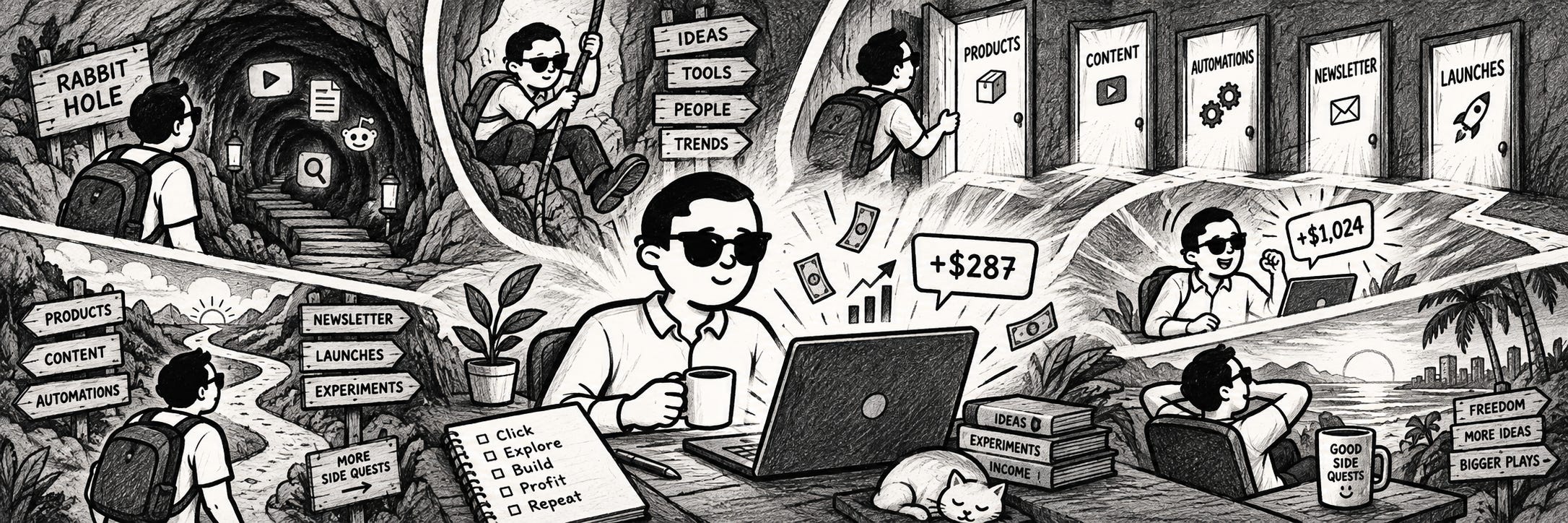
Because lately I’ve found myself back in the very part of internet businessing that I enjoy most: chasing internet rabbit holes, clicking a ton of buttons, building weird shit, and seeing if any of it turns into good ol’ cold hard American dollar bills.
Also summarizes pretty well what this entire newsletter is going to be about.
More on that in a second.
It all started with a sticky note
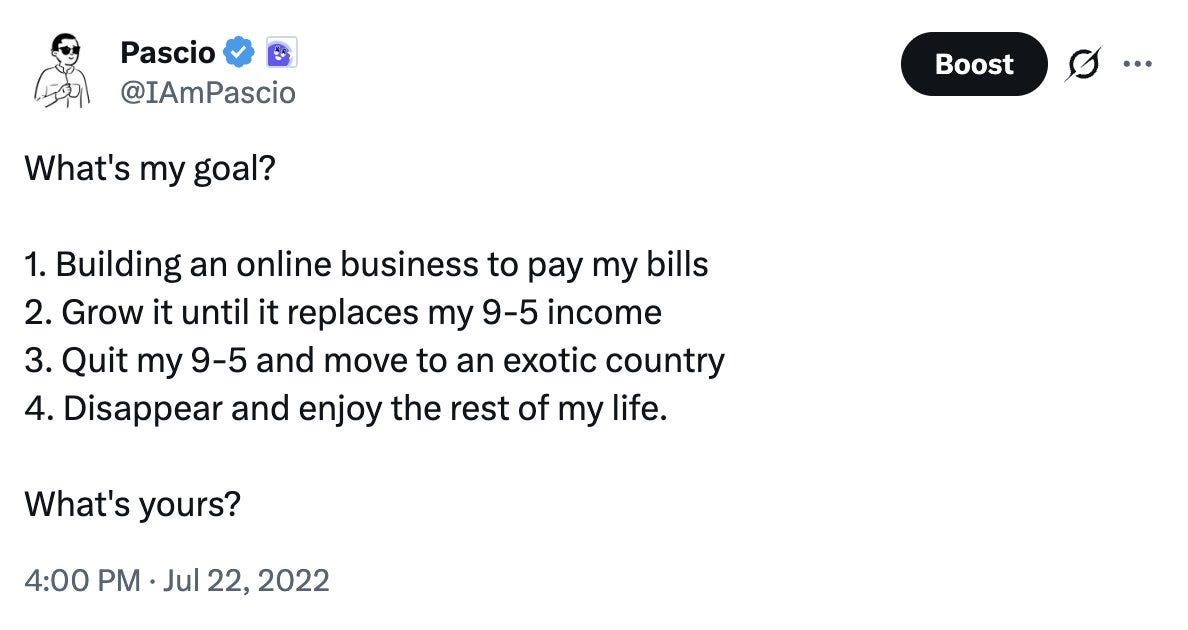
About four years ago, I wrote a list of my top goals on yellow sticky note.
Later as I got started with my online business, I turned those goals into a tweet and posted it publicly on X for some of that good ol’ juicy accountability:
Admittedly, I still go back and look at that very tweet every once in a while. And more impressively, less than a year after posting the tweet, I had already checked off the first three goals on that list.
I am still working on the fourth to this day.
Before all this, there was very little evidence that any of it was going to happen in the first place if I’m being completely honest. See, I was stuck in this soul-draining 9-to-5 job where I was being forced (or, I mean, I did it willingly, but you know what I mean), to call strangers on the phone all day to try and sell them things they didn’t really want in the first place.
If you’ve ever done any type of outbound sales or telemarketing, you know what I’m talking about when I say “soul-draining”.
Now as a result of the crippling depression that was creeping up on me, I spent most of my free time trying to figure out how the hell people made money online.
I tried a lot of things over the years.
One of my earliest genius business ideas was dropshipping women’s clothes. The rationalization on this was very real, and it was simply because my girlfriend was spending lots of money buying clothes every month, so I reasoned with myself that this niche would definitely be the one to make me filthy rich.
Oh boy, had I only known what I was in for…
I ended up burning around $9,000 running paid ads before eventually accepting that I had created a remarkably efficient system for sending money from my bank account directly to Facebook, and not so much a business that got me paid (lol).
After that experiment, I had no more money to play with.
So I decided to go all in on content, because, well… it was free to create and post.
Problem was that I had never created content before and I had no idea what to create it about, so again, my master rationalization skills came into play when I woke up one day and realized that I could just make a page and talk about my goals.
So, as you know, my goal was to get rich and the result was an Instagram account called “The $1M Project”.
The concept was… exactly what it sounds like.
I was going to publicly document my journey to making a million dollars.
And so I began.
I made lots of content. The actual making money part proved… slightly more difficult.
For around three years, that was more or less my relationship with online business. I would discover something, become convinced I had finally figured it out, spend weeks or months working on it, and eventually move on to the next idea when I failed epicly.
Dropshipping. Instagram pages. Content. Random business models. Whatever rabbit hole looked promising that month.
I had plenty of ambition and very little to show for it.
So, eventually, I gave up entirely.
I decided to just get better at my job. And so I began climbing the corporate ladder instead. I studied sales, improved my skills, closed more deals and got promotion after promotion.
Eventually I realized that while the money got better, the depression didn’t.
So I turned to self improvement as the solution.
If I couldn’t change my life situation, well, the very least I could do was hit the gym.
That journey led me to the most random thing of all times:
Notion.
(or… if you just want to understand how I’m using
Internet Leverage to power and fuel these side quests,
read my personal newsletter Internet Leverage here instead)
The strangest thing changed my life entirely
As I got deeper into the self dev space, I ended up with my life organized in these neat Google Drive folders. One for each, Health, Wealth, Happiness. You know the drill.
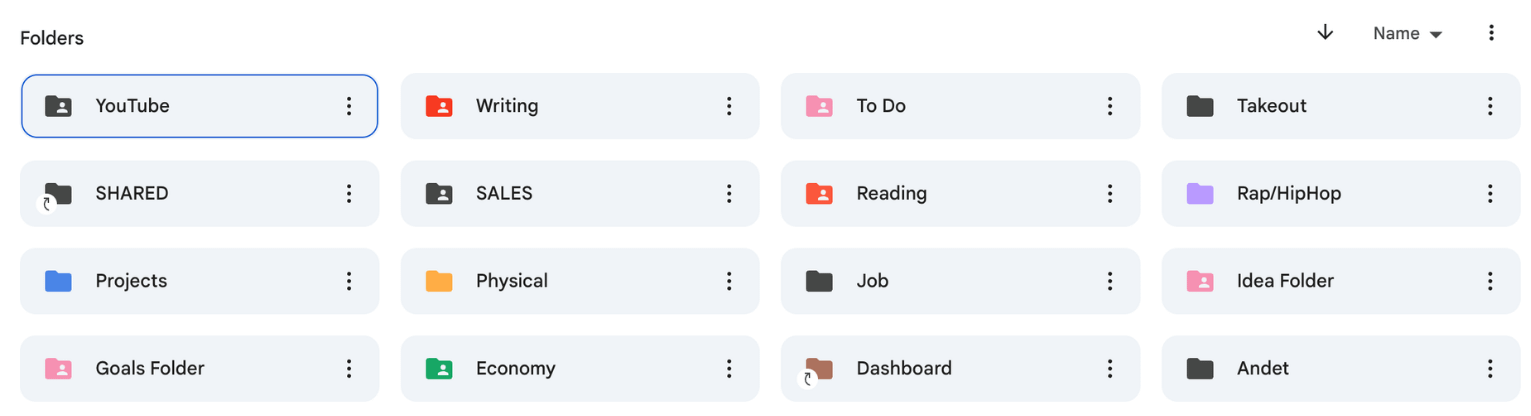
And I was proud of this system I’d built. So proud that one day I showed it to my brother who was a university student and an an avid user of Notion.
So he asked me, “why don’t you use Notion for this instead of Google Drive?”
I’d never heard of Notion, but gave it a shot and one weekend later, I was knee deep.
I got completely sucked into it, and started engaging in Notion communities.

Eventually along the way, I came across people that were making surprisingly good money selling templates for it. That caught my attention specifically.
Because if they could do it… why couldn’t I?
The business model was equally attractive. There was almost nothing standing between me and the customer. I could build the product myself, put it on the internet, find people who wanted it, and keep most of the money I made for myself.
So I started a faceless Twitter account from zero and began posting about Notion.
My early tweets got something like two likes each, and I remain fairly confident that both of them were from my mom (thanks mom!)
At the same time, I spent hours studying other successful creators trying to understand what people actually needed and would pay for. So I made systems for productivity, goals, businesses, habits, planning, and basically every other part of life people apparently wanted to organize inside a database.
While everyone shipped a template a month, I was launching one every week.
The first $5 I ever made online came from my first launch.
And I use the word “launch” generously.
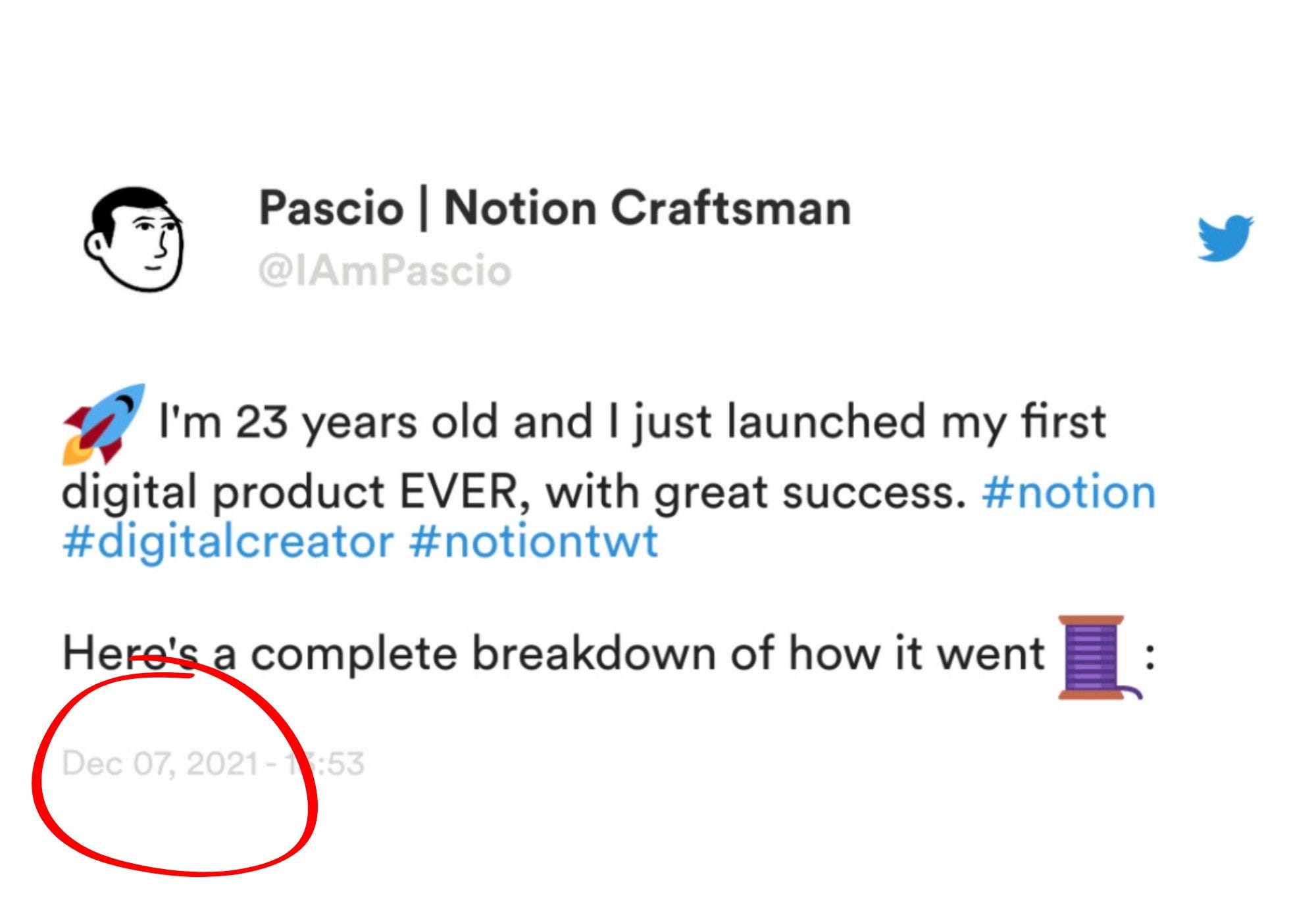
It looked ridiculous compared with how I (or half of Tech Twitter) would launch something today but still, someone bought it.
And then someone else. And another person. And another.
Before I knew it, I had made $200 over the course of a few days.
Pocket change, sure. But life-changing in the sense that it changed my life trajectory. And so, my account slowly grew, my products got better each time, and the income started growing at a compounding rate alongside it.
After around six months of hustling and bustling (while still working that 9-5), I hit my first $2,000 month. Then I did it again the month after. And again the next month.
At that point I quit my job and just went all in.
Everyone around me thought I had lost it. Understandable. Because from the outside, I had given up a stable, well paying job, with another promised promotion just about to hit + the yearly 0.5% raise kicking in,
… to spend my days tweeting anonymously from a cartoon character profile about a productivity app and selling digital planners to strangers on the internet.
I sounded ridiculous.
But from where I was sitting, it felt like I had finally found something with momentum after years of trying and failing at everything.
The five bucks kicked things off. The $200 launch made me believe it was possible and the $2k months were the nail in the coffin that told me THIS WAS IT: my way out.
So naturally, I wanted to see how far I could take it.
Turns out people really wanted their lives organized
After quitting my job, I now had 24/7 to ship products and write tweets.
And now that I think about that, that right there, that paragraph, is basically the one-sentence secret to succeeding in an online business with zero prior experience:
Ship products & write tweets 24/7.
My little internet business selling cute Notion templates eventually scaled to $300,000 in profits. And it was still just me, my laptop and Twitter.
The more interesting part was what started happening next.
My Twitter audience kept growing and my email list along with it. And for every new person who entered my world, the next launch became a little easier and more profitable.
Eventually I realized that the templates were only one part of the equation.
The real asset I was building underneath it all was distribution.
Once I understood that, I started stacking other things on top of what I already had.
I built info products. I ran mentorships. I began closing high-ticket clients. I did partnerships and collaborations. I started playing with software, investing, doing acquisitions, and other small and (often weird) internet businesses.
Some things worked incredibly well.
Others quietly disappeared and shall never be spoken of again.
Over time, that $300k from selling templates eventually crossed $1 million in total profit. And somehow, after all of that growth, I am still sitting here happily working from my laptop without a giant organization around me.
Notion kickstarted the thing. Twitter and email scaled it. And everything I learned along the way then opened up a much larger playground.
A playground that I genuinely believe everyone should get a chance to play on.
(or… if you just want to understand how I’m using
Internet Leverage to power and fuel these side quests,
read my personal newsletter Internet Leverage here instead)
The fine print
I think we can agree that the clean version of this story sounds pretty sweet.
It’s also the one I tell at dinner tables and cocktail parties when people ask me what I do and I answer “online business” and they look at me with these weird eyes waiting for me to elaborate.
But you and both know that it’s really just the nice wrapper:
I discovered Notion, started a Twitter account, sold some templates, built an audience, quit my job, and eventually made more than $1 million online.
When you actual unpack it by zooming out a bit, the timeline is much uglier.
I spent 3 years trying random shit online, failing most of it. I burned thousands of dollars. I spent hours and hours making content nobody cared about.
And even then, my ambition started way before any of those failed business attempts.
This is equally important because I have that same tendency today.
I get curious about something, go too deep, start building, and occasionally emerge on the other side with an actual business.
The cool thing is that because I’ve already laid the groundwork, I have a lot more leverage to take bets now:
I have an audience. I have distribution. I have capital. I have experience.
And even cooler, now AI has made it possible for a non-techy guy like me whose only coding skill is Notion formulas, to build things I would have needed a team for a few years ago.
Which makes this a very fun time to start experimenting again, which brings me to…
Welcome to Side Quests
You’re reading Side Quest #1 of Side Quests. My newest lil’ project.
See, over the last few years, Pascio became associated with the things I had already built. I became “The Notion Guy”, which kinda boxed me in and limited my curiosity from exploring beyond it.
Today, I’m already experimenting and testing and fooling around, chasing internet rabbit holes and clicking a whole bunch of buttons to make money appear.
I want Side Quests to be the newsletter that documents that, WHILE it happens.
The easiest way I can describe it is this:
Side Quests is my weekly field log from the trenches. I’ll share the businesses I’m building, products and prototypes I’m shipping, launches, growth experiments, acquisitions, weird ideas, numbers, failures, and whatever I’m currently trying to figure out as I go.
Occasionally, a very stupid side quest turns into something that actually makes money.
That is the fun part.
There are plenty of places online where you can read the polished case study six months later, once somebody knows which decisions were smart and which details should conveniently disappear from the story.
Here, I want to write while I’m still figuring it out.
If I start something on Monday, I might tell you about it on Friday. If I spend money buying some strange internet asset, you’ll get the numbers. If I launch something and nobody cares, that can make the newsletter too, so we can all analyze why it wen’t wrong (after we stop collectively crying about it of course).
And if an experiment suddenly takes off and starts printing dough, you’ll see what happened before I have time to rewrite the story into some genius master plan.
You’ll probably notice a few recurring themes in this newsletter:
Profit & Prototypes will cover the things I’m actually building and my tests to see whether anyone wants to pay for them.
Build Logs will go deeper into active projects, what shipped, what broke, what changed, and where I’m taking them next.
Internet Experiments will be the stranger stuff: distribution ideas, viral mechanics, new channels, weird websites, growth loops, and ideas I’m testing because I want to know what happens when I play with different variables.
I’ll also share the economics when it matters, because why not?
Revenue, costs, traffic, users, valuations, prices, whatever gives you the full picture.
And there will inevitably be rabbit holes that begin with me thinking, “huh, that’s interesting,” and end three days later with twelve browser tabs open and a half-built company.
Those probably deserve their own category, but rest assured, I shall definitely let you know about those too, so you can avoid wasting time and have me do it for you!
(or… if you just want to understand how I’m using
Internet Leverage to power and fuel these side quests,
read my personal newsletter Internet Leverage here instead)
I already have a new side quest
A few days ago, I started building an Apple Watch app.
The original thought was simple. I use different AI agents for different parts of my life and work, and I wanted a way to speak to them directly from my wrist without constantly pulling out my phone.
So I started coding it.
You can see some of that here:


I have no idea yet where it ends up.
It could become a proper product. It could lead me into a much bigger idea. It could end up in the enormous graveyard of things I found fascinating for four days before becoming fascinated by something else.
Either way, that process is exactly what belongs here.
I have a bunch of these experiments going at any given time. Software, content systems, acquisitions, little internet businesses, distribution plays, AI tools, and other things that probably make more sense once I have spent an unreasonable amount of time explaining them.
Side Quests gives me somewhere to document all of it.
And hopefully, seeing it will help you too whether it’s you seeing what to avoid, getting motivated or just copying my moves (permission granted)!
One more important note
There is one other thing I want to explain, because I’m increasingly getting questions about the difference of Pascio vs. Pascal.
@IAmPascio (my faceless brand) is the builder side.
That is where my side quests live. I build things, launch things, experiment, share numbers, chase opportunities, and generally use whatever leverage I have accumulated to see what I can make happen on the internet.
This newsletter, and generally the Pascio brand, belongs to that world.
@CreatorPascal (the real me) is my personal brand.
This is where I go deeper and zoom out on the bigger picture of what building a 7-figure one person internet empire really is like.
I recently renamed that newsletter Internet Leverage.
The question behind it is something I spend a lot of time thinking about:
What becomes possible when one person suddenly has access to distribution, software, AI, capital and a global market?
Over there, I write longer essays about one-person businesses, attention as an asset, AI as leverage, internet-native wealth, ambition, culture and philosophy. More broadly, I’m interested in what happens as technology rewires how we work, think and live, and how you can use those shifts to get ahead.
Some of those essays are practical field guides.
Others are me following an idea until I understand it better.
For whoever reads it, the end goal is giving them an edge.
A way to learn the new rules of internet business while everyone else is still playing by the old ones, spot opportunities earlier, make better bets, and compound that advantage across work, money and life.
That is Internet Leverage by Pascal.
Side Quests by Pascio is much closer to the ground.
One is where I think through the larger ideas and try to make sense of where all of this is going and what I’m learning from it in real-time.
The other is where I open the laptop and actually start fucking around with it and showing you what happens when you do.
And I think it’s a pretty genius move, because they feed each other naturally.
The things I build give me new ideas to think about. The things I think about usually give me another excuse to build something.
It turns out my business and my personality have basically become an infinite side-quest generator.
So... what happens now?
I genuinely don’t know.
That is partly why I wanted to start this first newsletter sidequest.
I’m in a very different position from the guy who was desperately trying to make his first few dollars online. I have distribution, capital, skills, an audience, and most importantly, access to technology that lets one person do things that would have required an entire team back when I started.
I still have the same itch to see what happens if I follow an interesting idea far enough.
Maybe the next side quest becomes another $300,000 template business (I heard Framer templates should be pretty profitable these days?)
Maybe it becomes software (maybe another AI Head of Content like Stanley?)
Maybe I buy something (so far, I’ve only sold some of my businesses, never bought).
Or maybe I build something so stupid that the only responsible thing to do is send you an email about how badly it failed so you can avoid it at all costs.
If you ask me, either of those outcome sounds far more interesting than pretending I already know the ending.
So a few times a week, I’ll come back here and tell you what I’ve been building, testing, launching, buying, breaking, learning, and making money from.
You’ll see the process while it is still messy + the numbers + the failures along the way.
And, if history is any indication of whether I’ll succeed, well, I’m a strong believer that least a handful of these ridiculous rabbit holes should eventually turn into something that can fund my new IRL garden project (srsly, I need me some more tomato plants, the first one I just planted produced… 2 tomatoes).
Welcome to Side Quests.
See you in the next one,
Pascio
Thanks for reading Side Quests!
Side Quests is my weekly field log from the trenches, covering the businesses, products, prototypes, launches, growth experiments, acquisitions, weird ideas, and whatever else I’m currently trying to figure out.
More often that not, a very stupid side quest turns into something that makes money and this letter is where I share the entire process, including the numbers, mistakes and failures along the way.
Subscribe now to join 34,000 other people tagging along for the wild ride!
(or click here to read a few editions first)
Things I am working on outside this, in case any of them are interesting:
If you want to build a High Profit One-Person Empire™, read this free article.
If you want to grow on Twitter, check out Stanley, my AI Head Of Content.
If you want to understand what fuels these experiments, check out Internet Leverage, my personal newsletter where I share weekly insights and essays.
Very cool! Loved reading the story behind it. Looking forward to more ◡̈
Love it Pascal. 🙏